
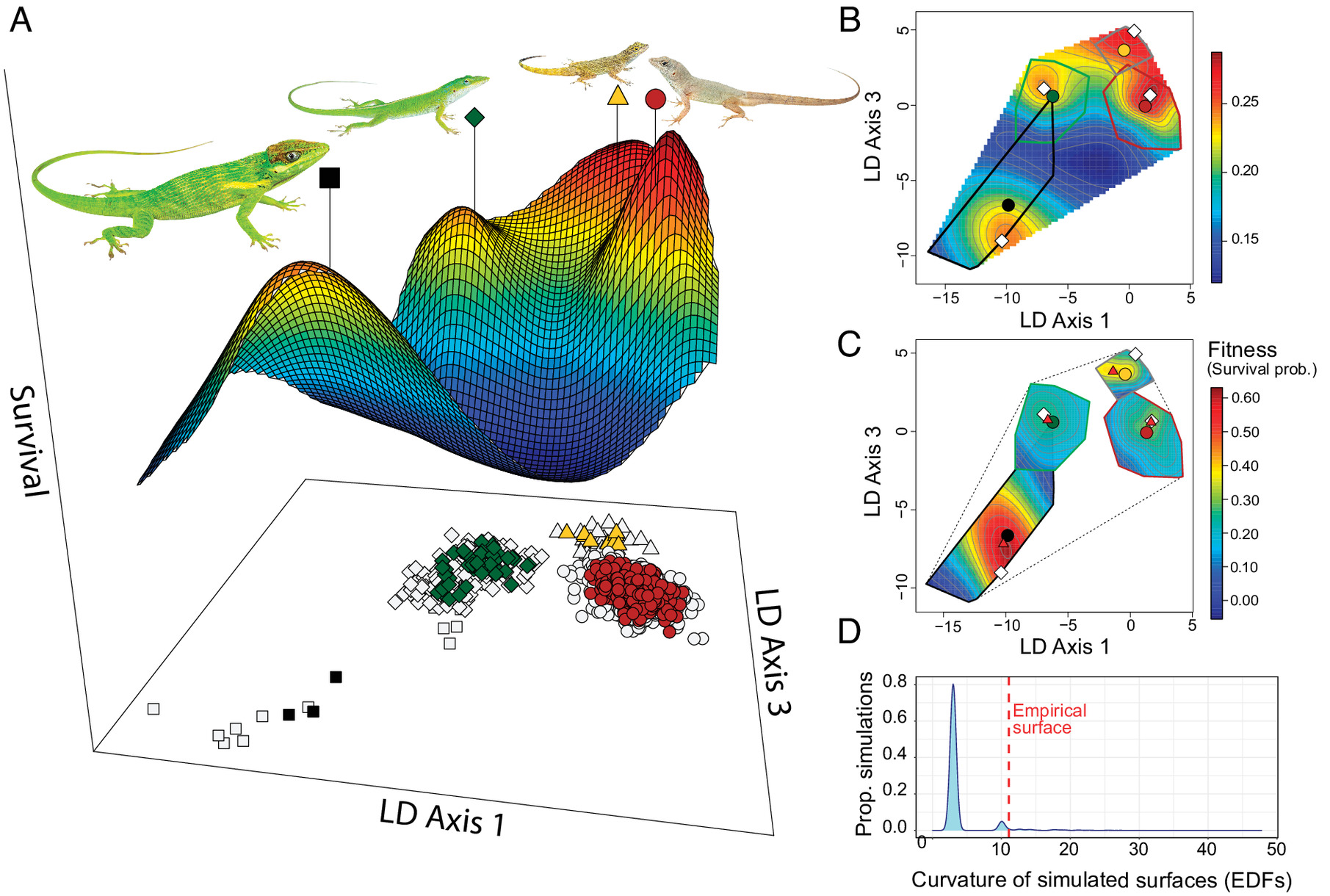
 A multi-peaked fitness landscape underlies the observed anole community on Lizard Island, a result we published in PNAS in 2023.
Measuring natural selection in the wild
Our long-term study on Lizard Island asks how natural selection actually operates across individuals, species, space, and time, not in theory but as a measurable process in a real natural community. The community has five species: two semi-terrestrial specialists, two arboreal canopy specialists, and one tree trunk specialist. We sample every single lizard--between 800 and 1,000 lizards at any given time--every every spring and fall.
Sampling twice a year lets us measure selection through the summer reproductive season and separately through the winter non-reproductive season, resolving variation that an annual census would be unable to recover. The study began in Fall 2015 and has run since (albeit with a forced hiatus during COVID).
Our Lizard Island field study is modelled on Peter and Rosemary Grants' exceptional long-term evolutionary field study of Darwin's finches in the Galápagos - our ambition is for Lizard Island to be the lizard analogue!
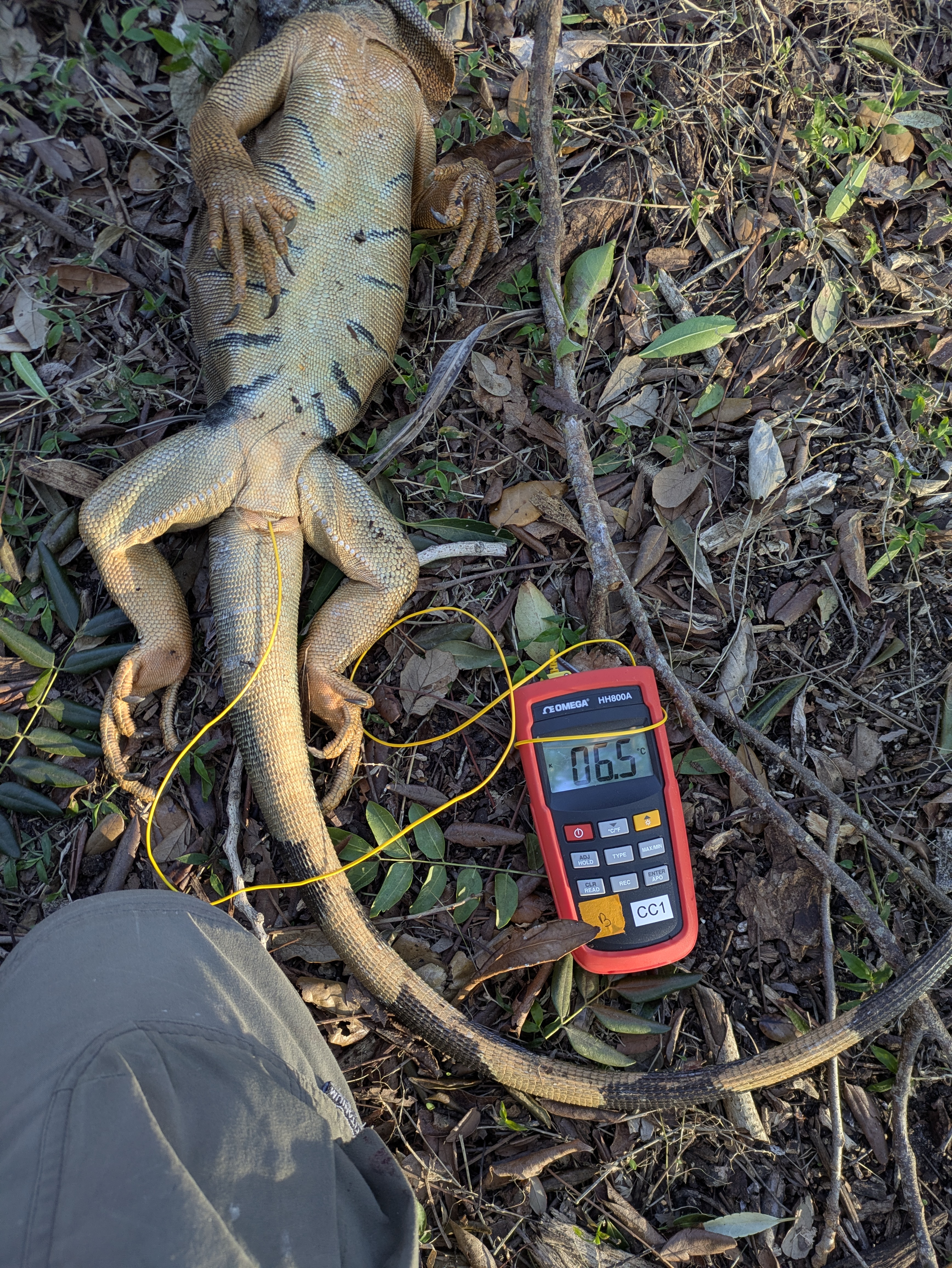 A cold-stunned green iguana (Iguana iguana) in the wild
during an extreme cold event in south Florida.
A cold-stunned green iguana (Iguana iguana) in the wild
during an extreme cold event in south Florida.
The evolution of thermal ecophysiology
How do ecology and behavior shape the evolution of thermal physiology? We approach this from two directions.
The first is a gradient, on which we are perfectly situated here at Georgia Tech in Atlanta, Georgia. Green anoles naturally colonized south Florida from tropical Cuba about 5 to 7 million years ago and now live all of the way north into deeply temperate Tennessee and North Carolina. Our initial work suggests that changes to thier physiological tolerance limits are not what facilitated this range expansion: lower thermal limits differ surprisingly little across that range, especially set against how much the enviornment itself varies thermally. Instead, behavior is what differs. In regions where air temperatures drop below their green anole's critical cold tolerance limit, they stop being obligate arboreal specialists and move down into subterranean thermal refugia. The major ecological transition has been the key to unlocking a tropical-to-temperate transition, which is notoriously difficult to achieve.
The second is speed. How fast can any of this happen? The tropical lizards that have arrived in Florida over the past century give us contemporary introductions with known start dates, allowing us to estimate both the adaptive pathways--and rate--of evolutionary response. We combine ecological, physiological, and genomic and transcriptomic approaches, working toward an integrated account of how species can rapidly adapt to their local environments.
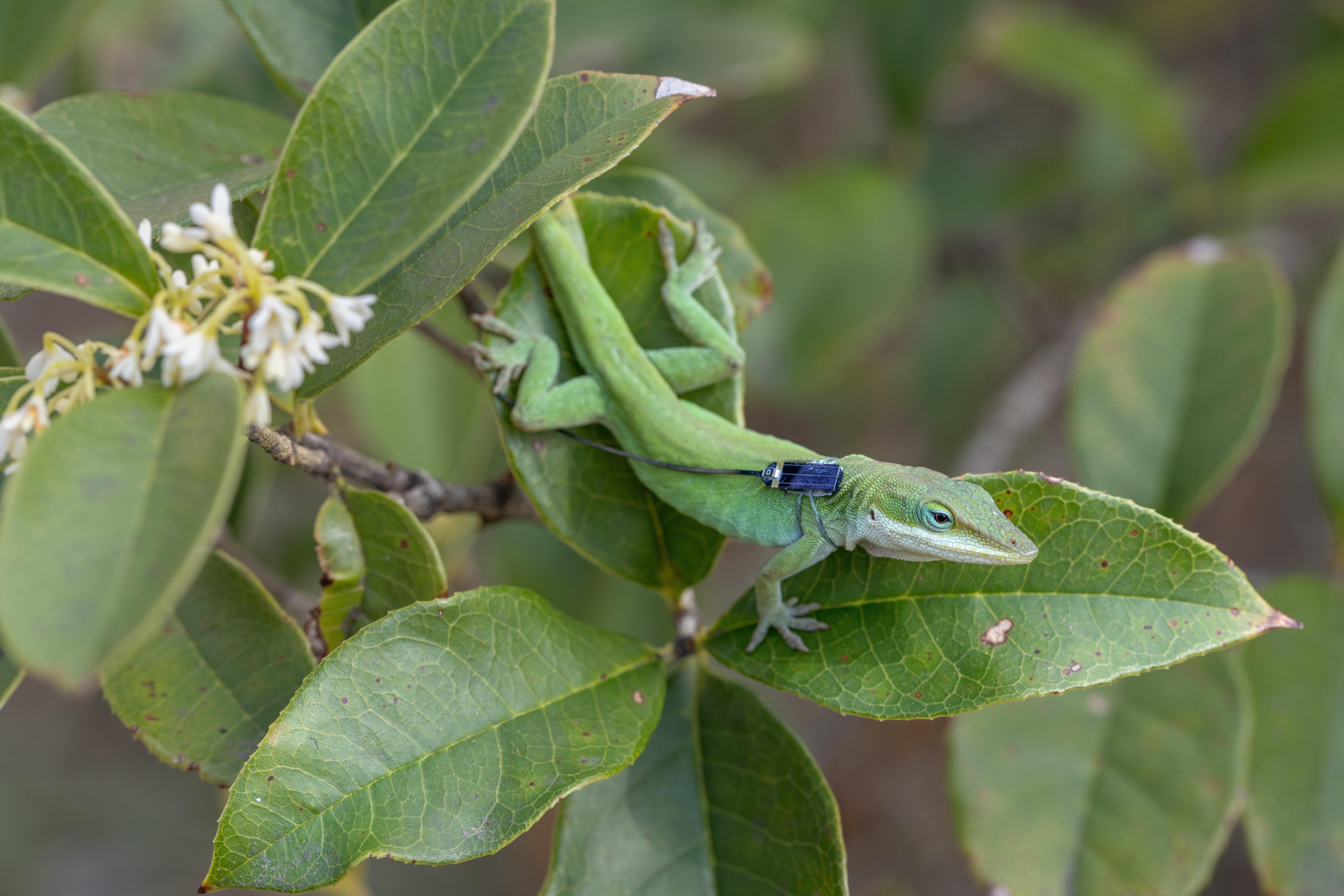 A green anole with an ultra-lightweight wearable tracking sensor.
New technology for eco-evolutionary field studies
These research objectives take advantage of where the lab sits. Georgia Tech is one of the best engineering and computer science universities in the world, and integrating those tools into eco-evolutionary field work is the current frontier of the discipline.
We are confident that advanced instrumentation of both orgnaisms and ecosystems in the wild is the future of ecology and evolution. For example, ultra-lightweight wearable sensors let us track movement, behavior, physiology, and interactions passively, on free-living animals, in ways that were not previously achievable. We also employ annual terrestrial LiDAR scans of Lizard Island, which is letting us identify and measure the entire structural environment: in other words, we know exactly the location and size of every branch on the island, information that is critical to understanding natural selection in our anole community. We are developing our own machine-learning software for various research tasks in the lab, such as automated landmarking of our lizard radiographs and toepad scans, and LiDAR point cloud processing.
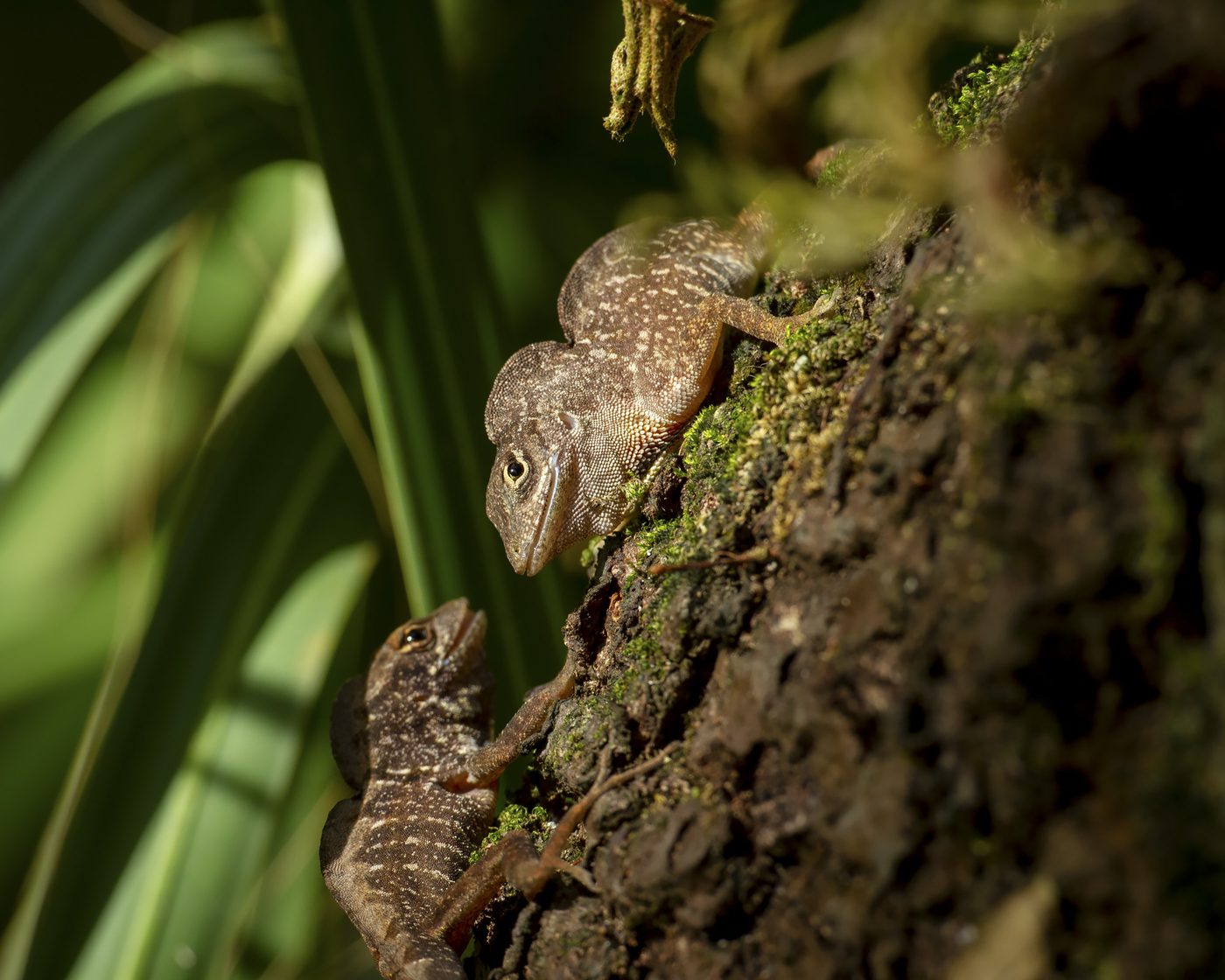 Anolis sagrei, the brown anole: one of the introduced species
whose known arrival dates make South Florida a natural experiment.
Anolis sagrei, the brown anole: one of the introduced species
whose known arrival dates make South Florida a natural experiment.
Introduced species as natural experiments
A theme running under all three of the programmes above is our use of introduced species. Introductions are "natural" field experiments in ecology and evolution at temporal and spatial scales no one could (or would be allowed to) establish deliberately: novel abiotic conditions, novel species interactions, and communities assembling from scratch, all with a known start date. South Florida, where a diverse community of tropical lizards has arrived over the past century, is probably the best place in the world to take advantage of this.
They let us ask questions that are otherwise almost unaskable. How do species respond to novel abiotic environments? What are the outcomes of novel species interactions? How do communities assemble when every interaction is new? Do niches expand, contract, or stay stable during an introduction?
Foundations
Conceptual papers from the lab
These reviews and perspectives lay out the conceptual ground most of our empirical work is built on.
(2025) The American Naturalist, 206(5): 403-417.
(2025) Evolutionary Journal of the Linnean Society, 4(1): kzaf009.
(2025) Nature, 639: 589-601.
(2024) Nature Communications, 15: 9862.
(2024) Trends in Ecology and Evolution, 39(7): 677-688.
(2023) Proceedings of the National Academy of Sciences, 120(42): e2222071120.
(2021) Proceedings of the National Academy of Sciences, 118(1): e2018949118.
(2016) Annual Review of Ecology, Evolution & Systematics, 47: 507-532.